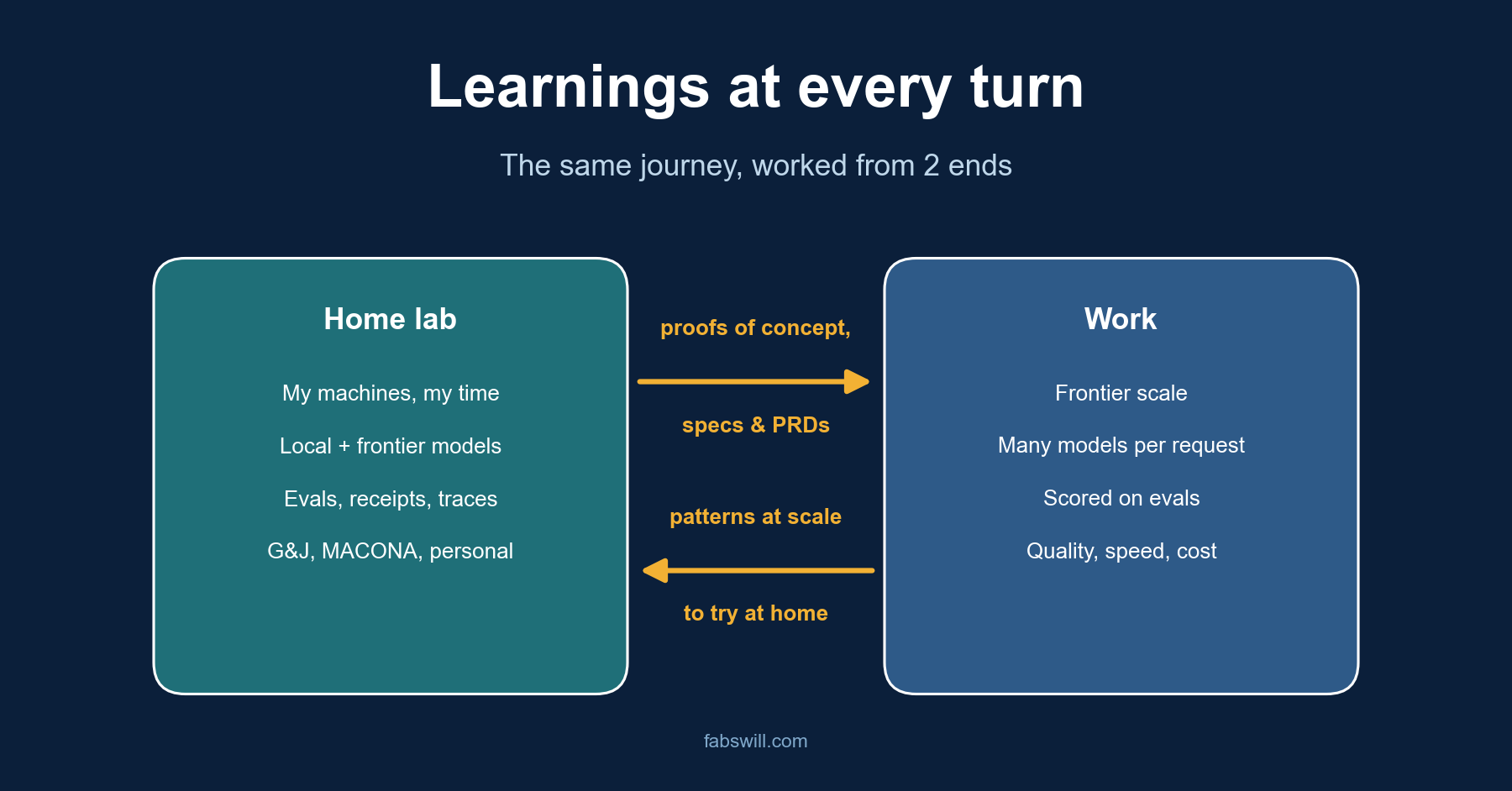
Learnings at every turn: the same journey, worked from 2 ends. A Home lab box (my machines, my time; local and frontier models; evals, receipts, traces; G&J, MACONA, personal) and a Work box (frontier scale; many models per request; scored on evals; quality, speed, cost). Arrows: proofs of concept, specs and PRDs go from home to work; patterns at scale come back from work to try at home.

Learnings at Every Turn: A Frontier-Scale Router Comes Home

BLUF (bottom line up front): Abram Jackson, PM for extensibility of Copilot for Microsoft 365, wrote this week: “Yes, it’s not just a simple router. We use multiple models for a single request, based on which combination scores highest on our evals.” My home lab has been teaching me the same lesson from the other end. Learning flows both ways: what I prove at home shapes what I take to work, and what I see at frontier scale at work shapes what I try at home. This post is the latest turn of that loop, and yes, the pun in the title is intended :-) ...
November 2, 2026 · 6 min · Fabian Williams
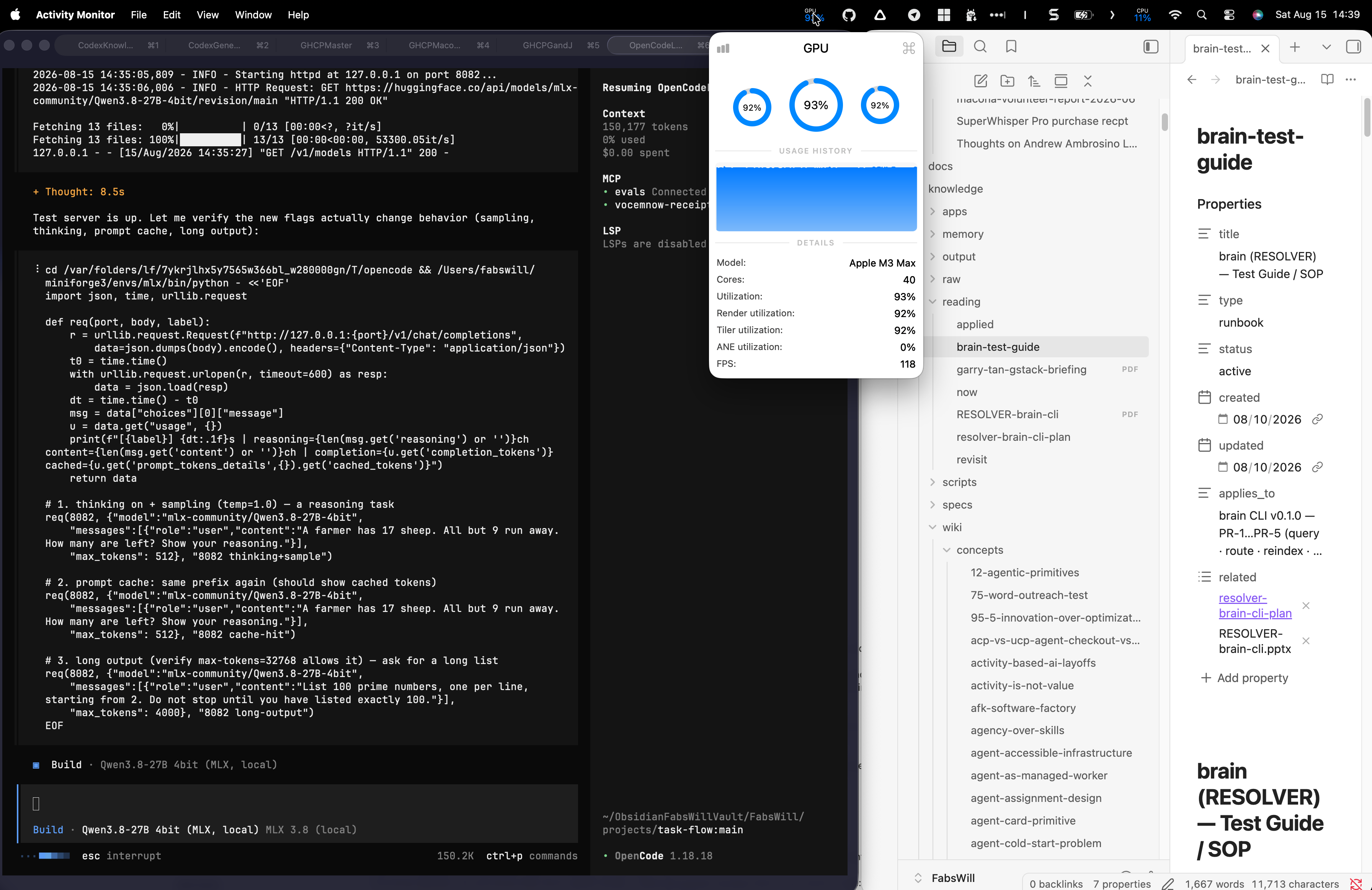
Activity Monitor showing the M3 Max GPU pinned at 92 percent while an OpenCode agent runs probe requests against a throwaway Qwen3.8 test server on port 8082

I Swapped My Local Coding Model Overnight From a Hotel. The Agent Graded the Upgrade Itself.

TL;DR Local models are how I run my community work, my volunteer projects, my side hustles, and my musings. Two reasons, both simple: Cost. None of this work should bill against a frontier account. Trust. Client and customer data stays on my own disk, away from the labs. Bottom line up front: I am running Qwen3.8-27B (4-bit) on my MacBook Pro M3 Max, 128 GB of unified memory and a 40-core GPU, my personal dev rig, driven by an OpenCode harness. ...

August 15, 2026 · 8 min · Fabian Williams
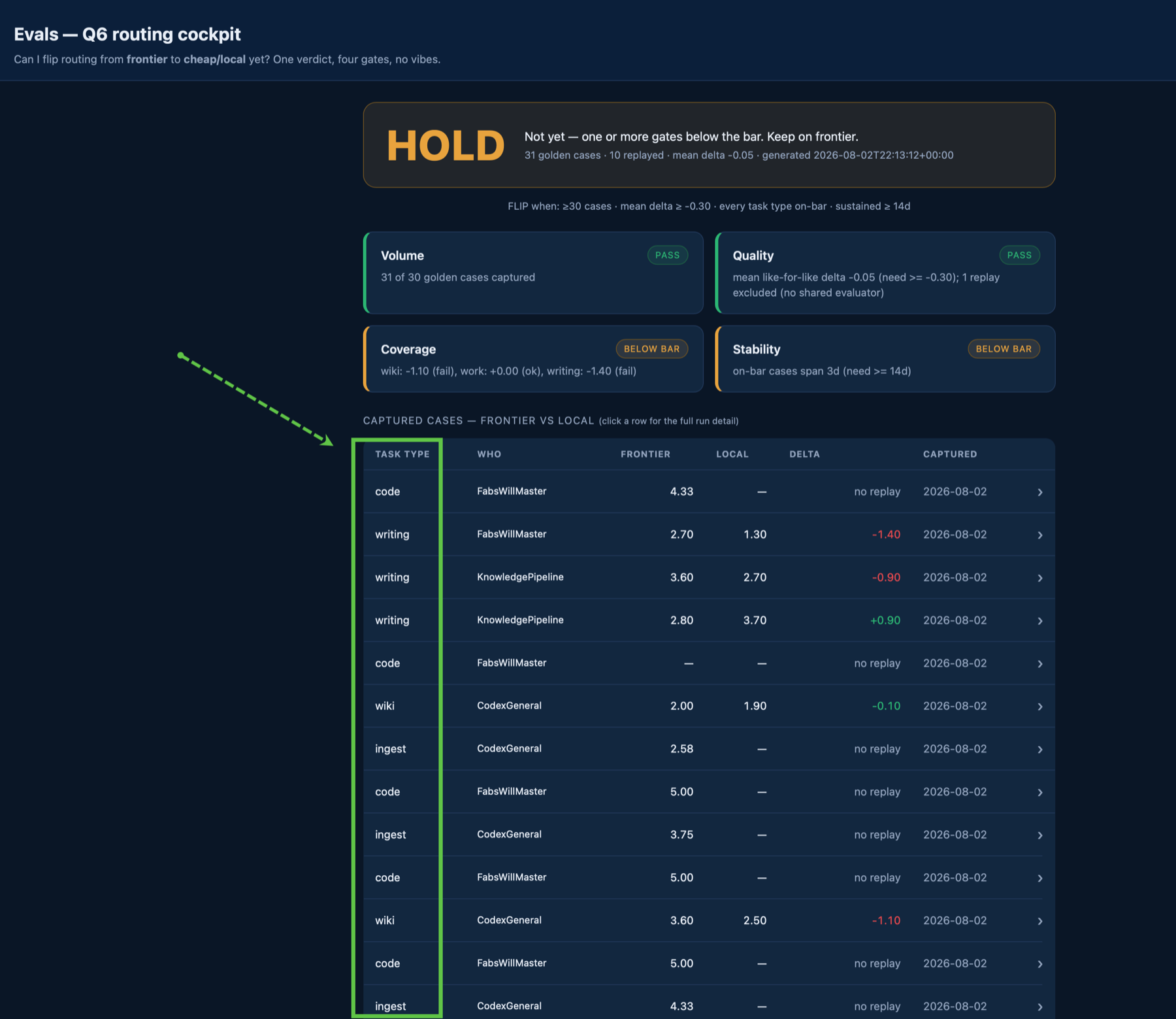
Eval cockpit showing the verdict panel: 31 golden cases, 10 replayed, mean like-for-like delta -0.05, with Volume and Quality gates passing

I Made My Evals Replay Every Task on a Local Model. The Frontier Lead Got Thin.

TL;DR My agents do real work on frontier models. Every dollar of that work is metered against my OpenAI and Anthropic bills. Meanwhile a perfectly capable local model, gpt-oss:20b, sits on a Mac Mini in my office costing me nothing. The obvious question: for which tasks could the free local model do the job just as well? Today I answered it with a system instead of a guess. I taught my eval framework to automatically replay every writing task on the local model right after the frontier model runs it, then grade both with the same judge and record the gap. The result across 10 like-for-like rematches: a mean quality delta of -0.05 — statistical parity — and four tasks where the local model actually scored higher than the frontier model, by as much as 1.7 points. ...

August 2, 2026 · 7 min · Fabian Williams