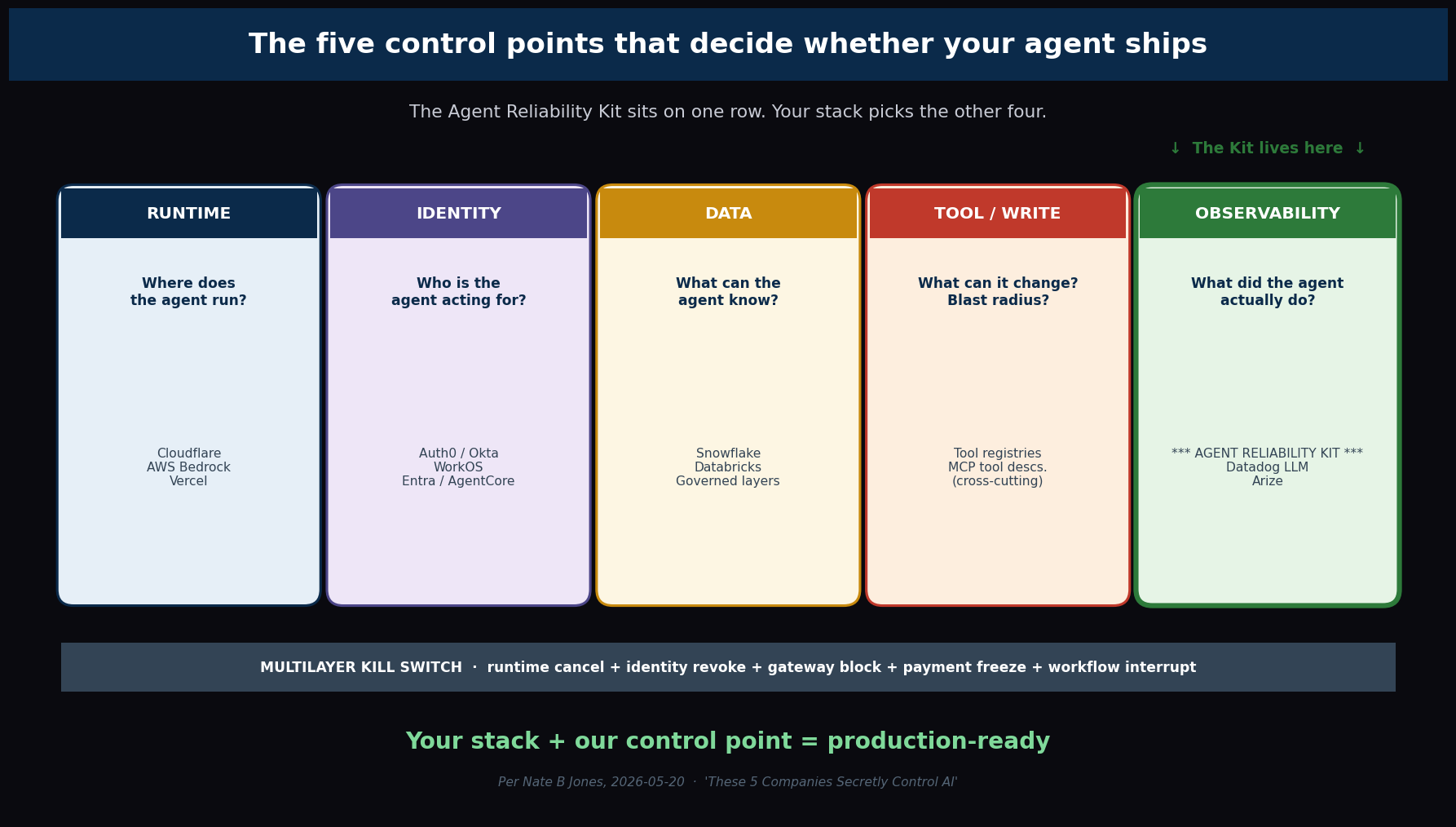
Five-box diagram of the agent infrastructure control points (Runtime, Identity, Data, Tool/Write, Observability) with the Agent Reliability Kit highlighted on the Observability box, plus a multilayer kill-switch strip across the bottom

Paying Down Supervision Debt: Why the Five Control Points That Decide Whether Your Agent Ships Have Nothing to Do With Your Model

By the end of this post you will know which of the five infrastructure control points your agent stack is shipping without, and you will have a concrete pattern for paying down the observability piece of that debt: a public, consumer-readable audit-trail receipt that satisfies both your security team and your finance team with the same document. The receipt was already in production when the broader practitioner conversation started naming the gap. ...
May 21, 2026 · 9 min · Fabian Williams
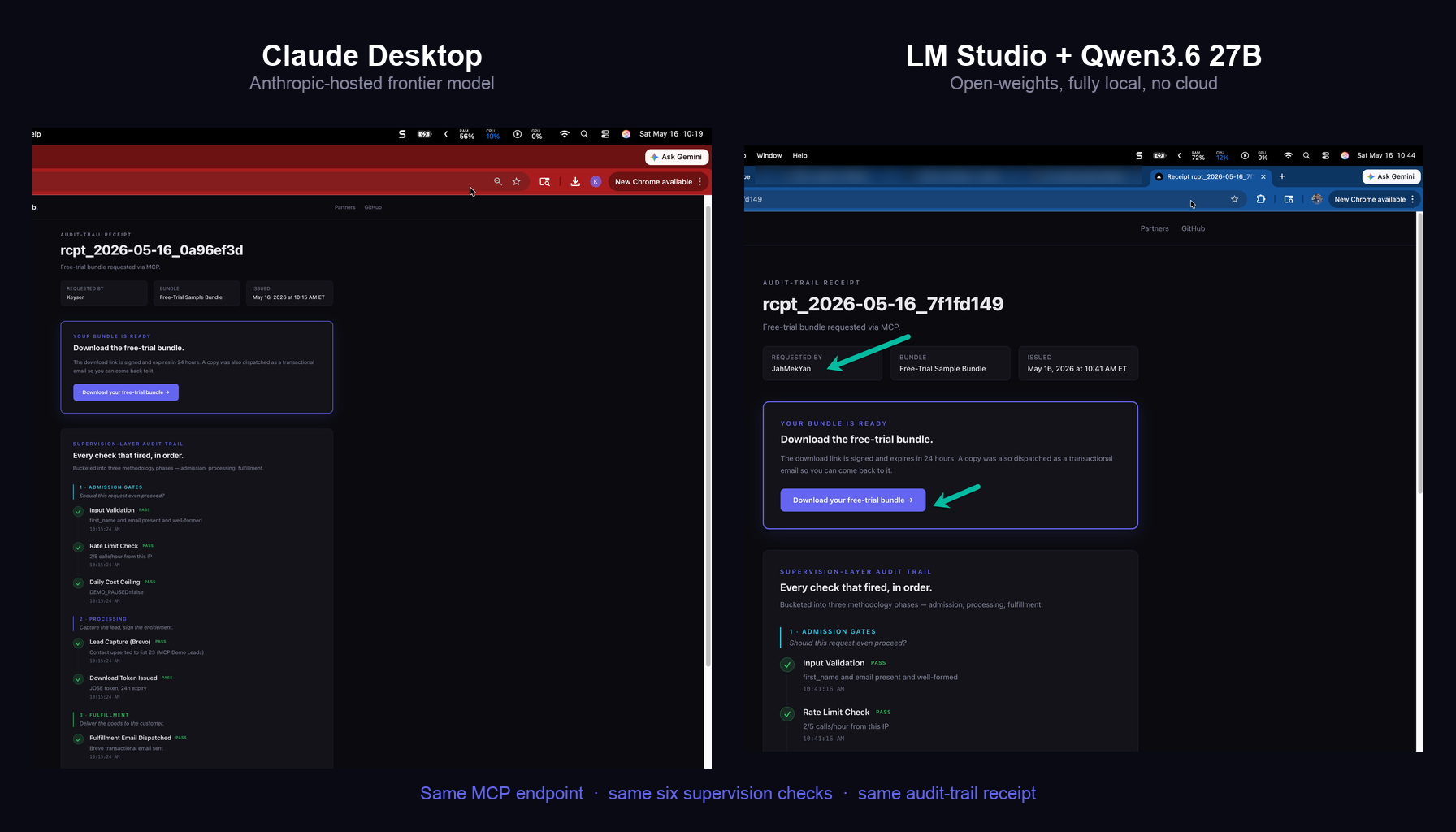
Side-by-side comparison of two audit-trail receipts — Claude Desktop on left, LM Studio with Qwen3.6 27B on right — both produced by the same MCP endpoint with identical six-check audit trail

One Agent Receipt, Two Buyers: Why Protocol-Neutral MCP Audit Trails Matter for Both Security AND Finance

Update, 2026-05-19: A2A agent-card now live at mcp.adotob.com/.well-known/agent.json, published 24 hours after Nate B Jones’s IO-2026 video named the agent-card primitive as the second of the four core agent-protocol layers. Three of the four layers of the open-protocol stack are now live in the storefront: MCP for tool access, A2A for agent discovery, and AG-UI manifested as the public receipt page. AP2/X402 is reserved for the MVP-2 paid Stripe flow. By the end of this post you’ll have two public URLs you can forward to your security team AND your finance team — and both audits get satisfied by the same document. That document is an agent receipt. The two URLs are real receipts produced by the same MCP endpoint, one driven by Anthropic-hosted Claude Desktop and the other driven by Qwen3.6 27B running fully offline on my MacBook. The point of this post is why that one-artifact-two-ledgers property matters more than the technology that produces it. ...

May 16, 2026 · 10 min · Fabian Williams
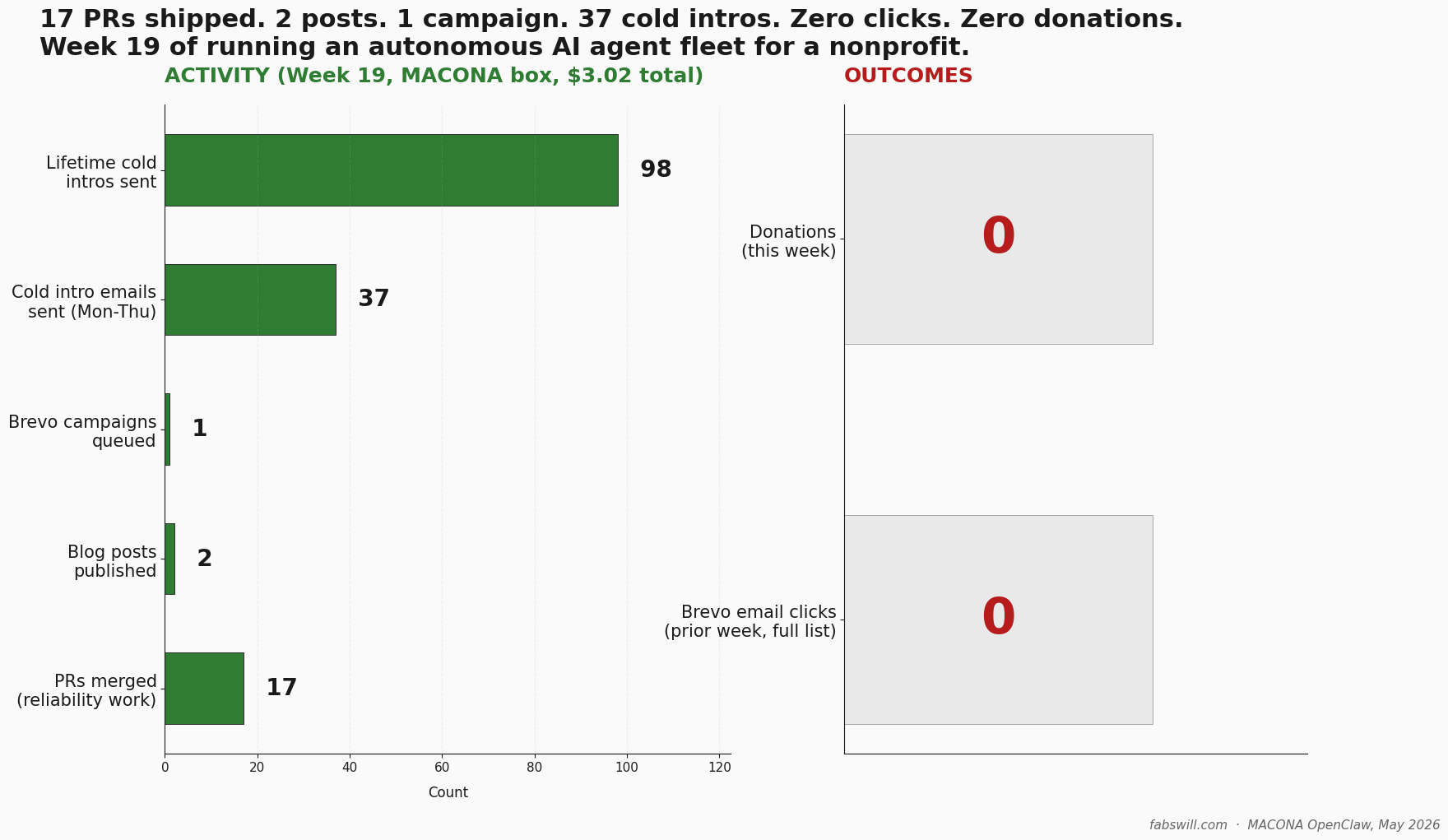
Two-panel chart: left shows 17 PRs, 2 blog posts, 1 campaign, 37 cold intros, 98 lifetime intros shipped in green; right shows zero human clicks and zero donations in red

The AI Agent Fleet Works. The Trust Funnel Does Not.

TL;DR I volunteer with MACONA, a 501(c)(3) nonprofit that ships food, medicine, feminine hygiene products, donated computers, and clothing to communities and schools in West Africa. For a few few monthis now I have run a small autonomous AI agent fleet for the organization: five named agents, cron-driven, running through OpenClaw on a simple Windows box. Week 19 (I track progress via week numbers for me and my Agents) looked like a win on every internal activity metric: 17 reliability PRs merged, 2 awareness-day blog posts published, 1 Brevo campaign queued, and 37 cold introduction emails sent. ...

May 11, 2026 · 14 min · Fabian Williams
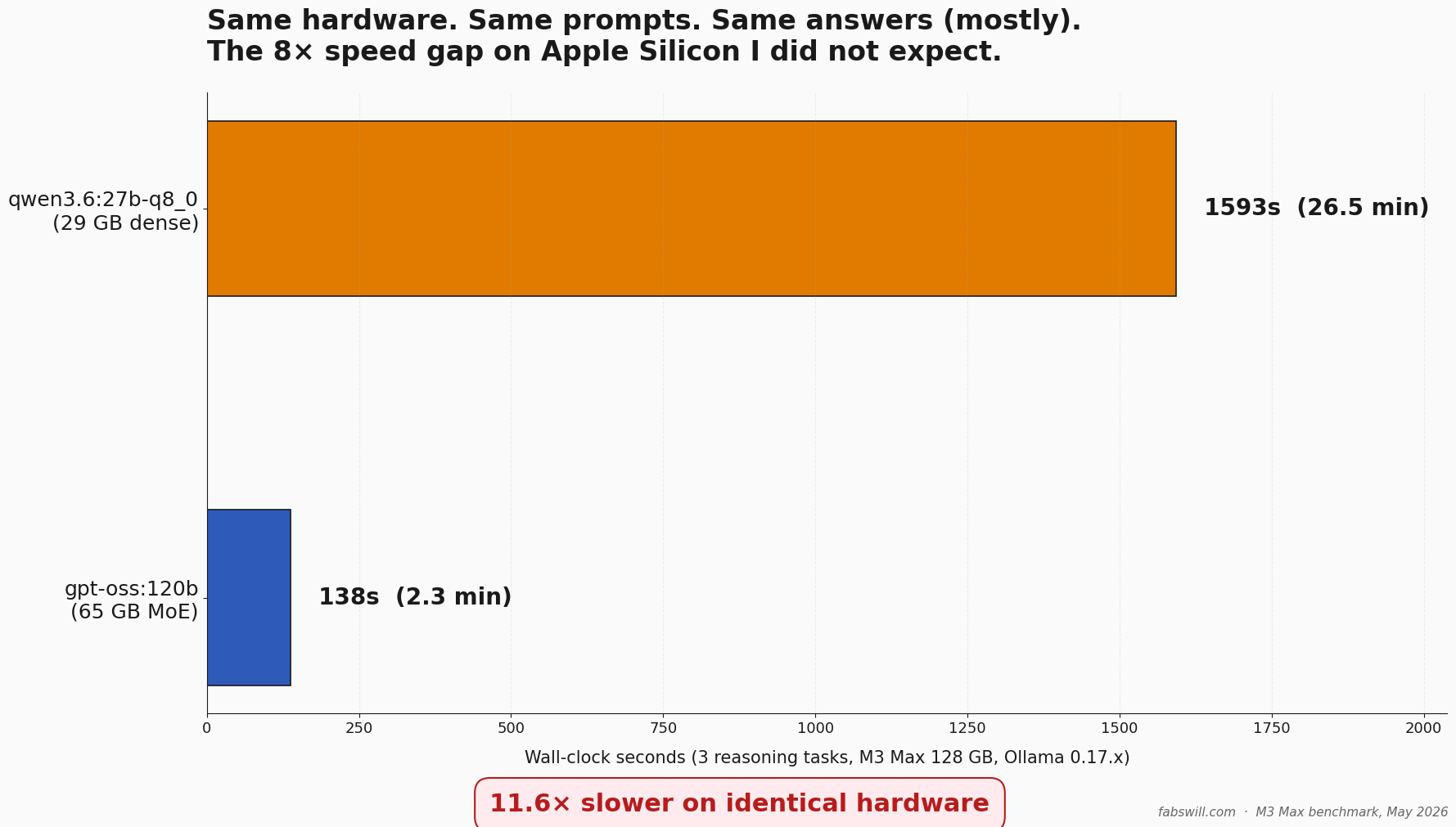
Horizontal bar chart showing gpt-oss:120b at 137 seconds and qwen3.6:27b at 1593 seconds on the same Round 2 reasoning tasks, with an 11.6× slower callout

Qwen 3.6 vs gpt-oss:120b on M3 Max: I Ran a Harder Test, the 8× Speed Gap Surprised Me

TL;DR I published a post last week about replacing gpt-oss:120b with Qwen 3.6 on my MacBook Pro M3 Max. The numbers in that post were real, but one set of tests was structurally gameable — 38 of 40 baseline images were the same class, so an “always-say-A” stub also scored 95 percent. I went back, designed three un-gameable reasoning tasks, and ran them against both local models on identical hardware. gpt-oss:120b finished the three tasks in 137 seconds. qwen3.6:27b-q8_0 took 1593 seconds — 11.6 times slower, on the same M3 Max, for the same prompts and essentially the same answers. This post is the methodology, the receipts, and the honest correction to the migration narrative. ...

May 9, 2026 · 11 min · Fabian Williams
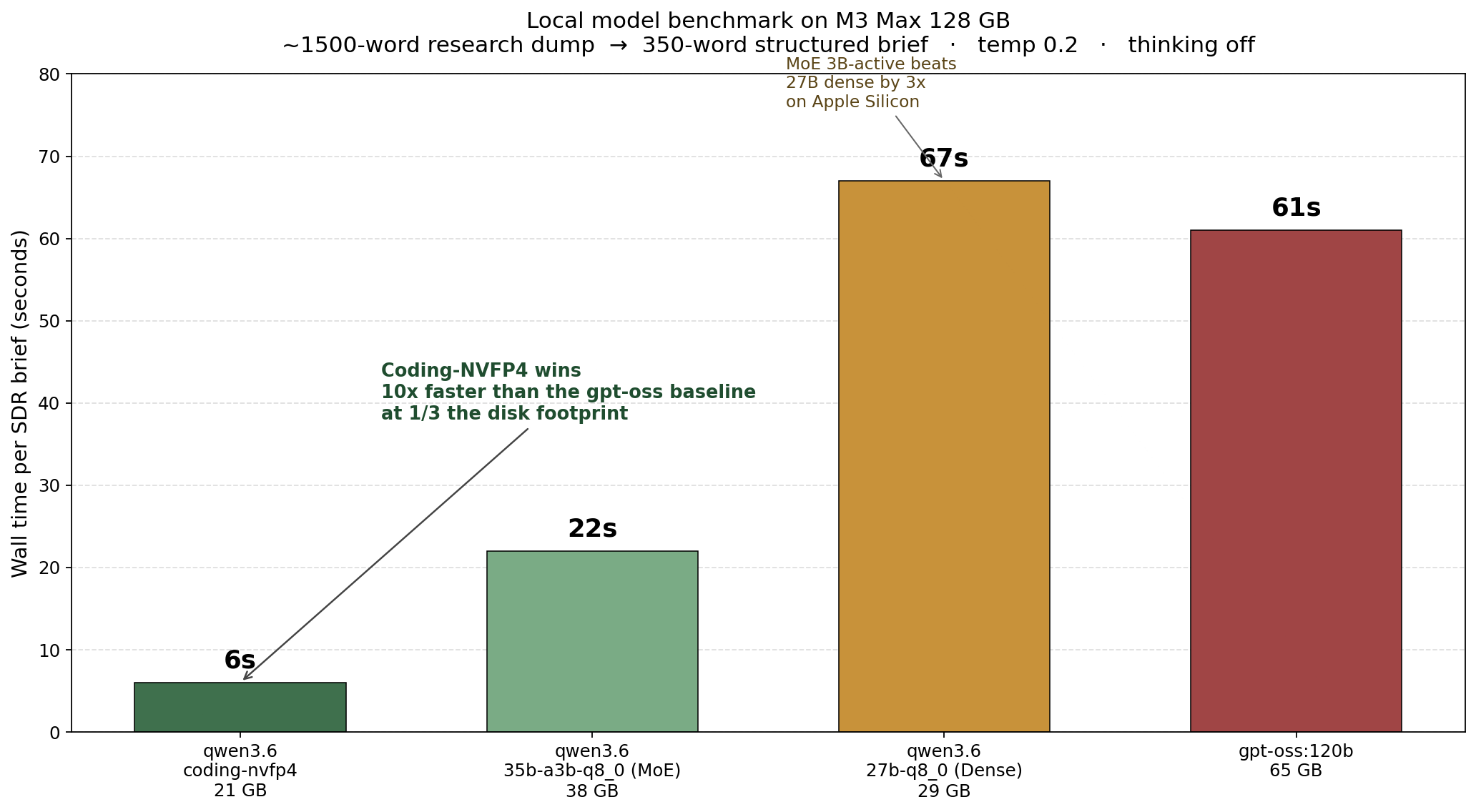
Bar chart comparing wall time of four local models on a structured-output benchmark

Replacing gpt-oss:120b With Qwen3.6 on a MacBook Pro: A Two-Day Local Model Benchmark

TL;DR I spent two days benchmarking three Qwen3.6 variants against gpt-oss:120b on my MacBook Pro M3 Max. The shocking result: a 21 GB coding-tuned model ran an OpenClaw-shaped research-brief workload that I use for the non profit MACONA.org in 6 seconds — 10x faster than gpt-oss:120b on the same prompt. Fast enough that I now have reasonable confidence I could move this kind of work off the SaaS-hosted frontier models I have been paying for and onto local hardware on my dev machine. The deeper finding: the same local model confidently hallucinated a description of an image it could not see, with no error and no warning. Local models are ready for production agent work — at least on hardware like this. Operational asymmetries are real. Verification is not optional. ...

May 2, 2026 · 14 min · Fabian Williams
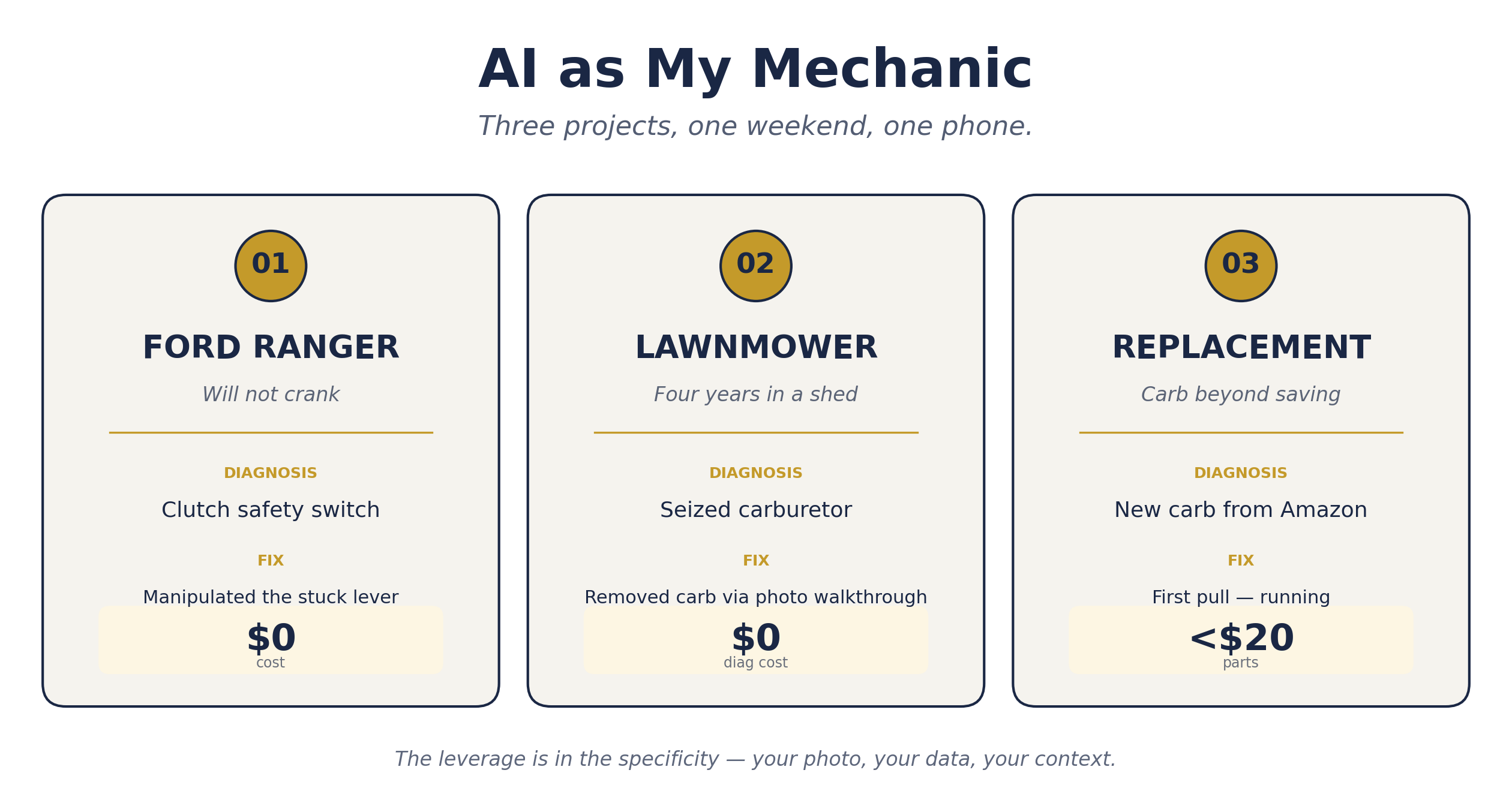
Three mechanical projects fixed with AI over one weekend — Ford Ranger, lawnmower carb removal, lawnmower replacement

AI Boosted My Mechanical Engineering Muscle

TL;DR Over one weekend I fixed a 2001 Ford Ranger that would not crank and a lawnmower that had been sitting in a shed for four years. The truck turned out to be a stuck clutch safety switch — cost, zero. The lawnmower needed a replacement carburetor from Amazon for under twenty dollars. I am not a mechanic. ChatGPT was my shop manual, and the whole thing was driven by photos of my actual parts, not generic internet tutorials. ...

April 19, 2026 · 5 min · Fabian Williams
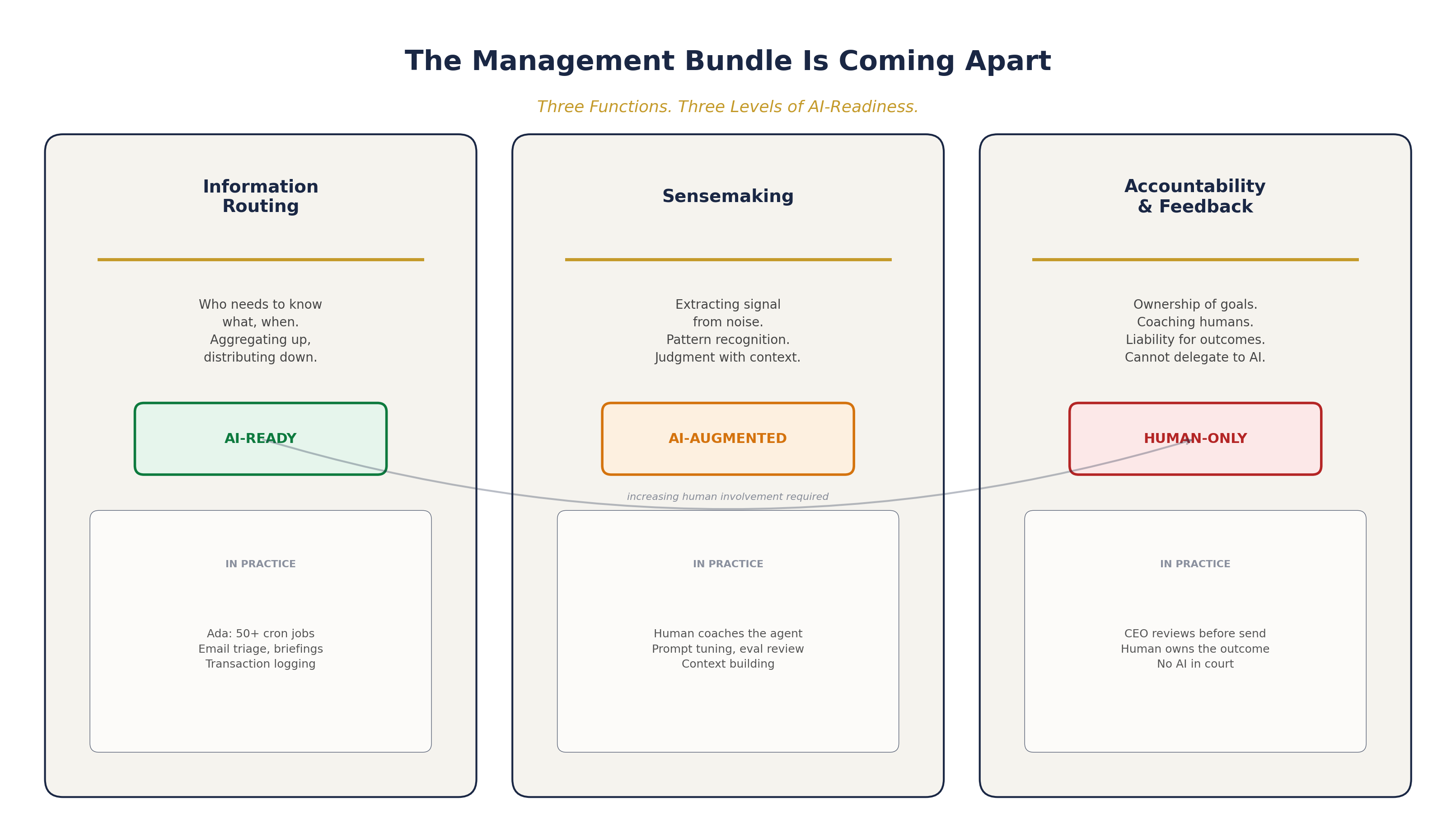
Three pillars of management unbundling — Information Routing (AI-Ready), Sensemaking (AI-Augmented), Accountability (Human-Only)

PM Life as Agents Take on More

TL;DR I had a sidewalk conversation with two neighbors that turned into a real-time debate about AI replacing jobs. Then I watched a Nate video that gave me the exact framework to explain why all 3 were right — and wrong. One neighbor is a project manager already using AI daily. One is a business analyst who coaches companies. One of my neighbours’ husband — a skeptic — is convinced AI cannot do creative work. All 3 are right in their position, and also all of us wrong, depending on which management function you are talking about. ...

April 12, 2026 · 9 min · Fabian Williams
Split illustration showing a human brain with fading neural pathways alongside an AI circuit board with data streams — bridging biological and digital memory

Your Brain Forgets Most of Your Life. So Does Your AI Agent.

TL;DR Neuroscientist Lisa Genova explains why forgetting is normal — your brain filters out most of your day, loses context when you change rooms, and is terrible at remembering future intentions. I watched her TED talk and realized I had already encountered every one of these failures in AI agents I build for real organizations. Here is how the parallels work, what breaks in production, and what I built to fix it. ...

April 12, 2026 · 11 min · Fabian Williams
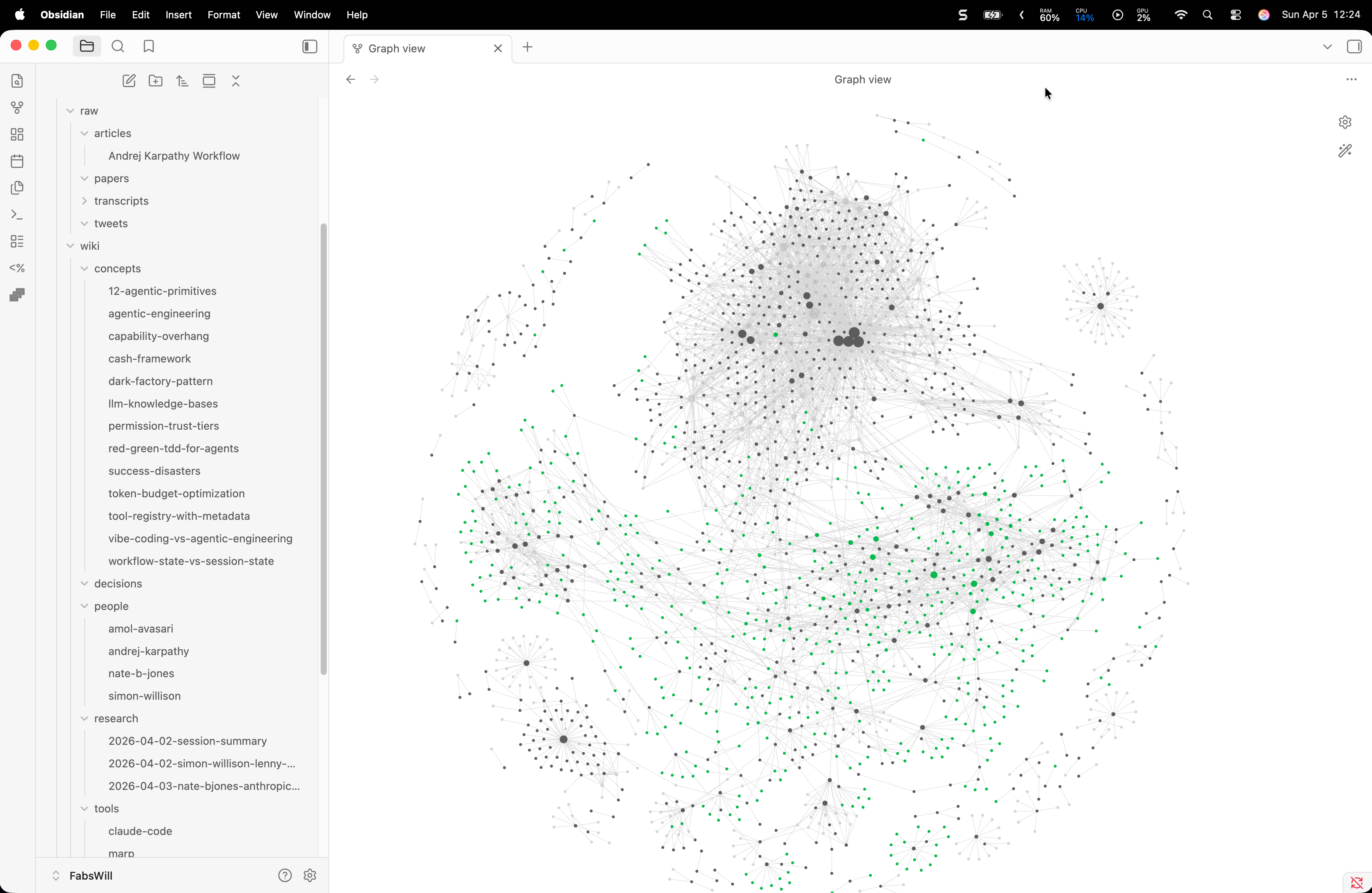
Obsidian graph view showing 21 cross-linked wiki articles compiled by Claude Code from raw transcripts

I Built a Knowledge Base That Writes Itself. Here Is What Andrej Karpathy Got Right.

TL;DR Andrej Karpathy tweeted about using LLMs to build personal knowledge bases — raw sources in, compiled wiki out, all in Obsidian. I implemented his entire workflow in one session using Claude Code skills. Four YouTube transcripts became 21 cross-linked wiki articles. The system now compiles new sources, health-checks its own consistency, and searches itself. It took an afternoon. It will compound forever. Your AI should not just answer questions. It should build a knowledge base that makes every future question easier to answer. ...

April 5, 2026 · 8 min · Fabian Williams
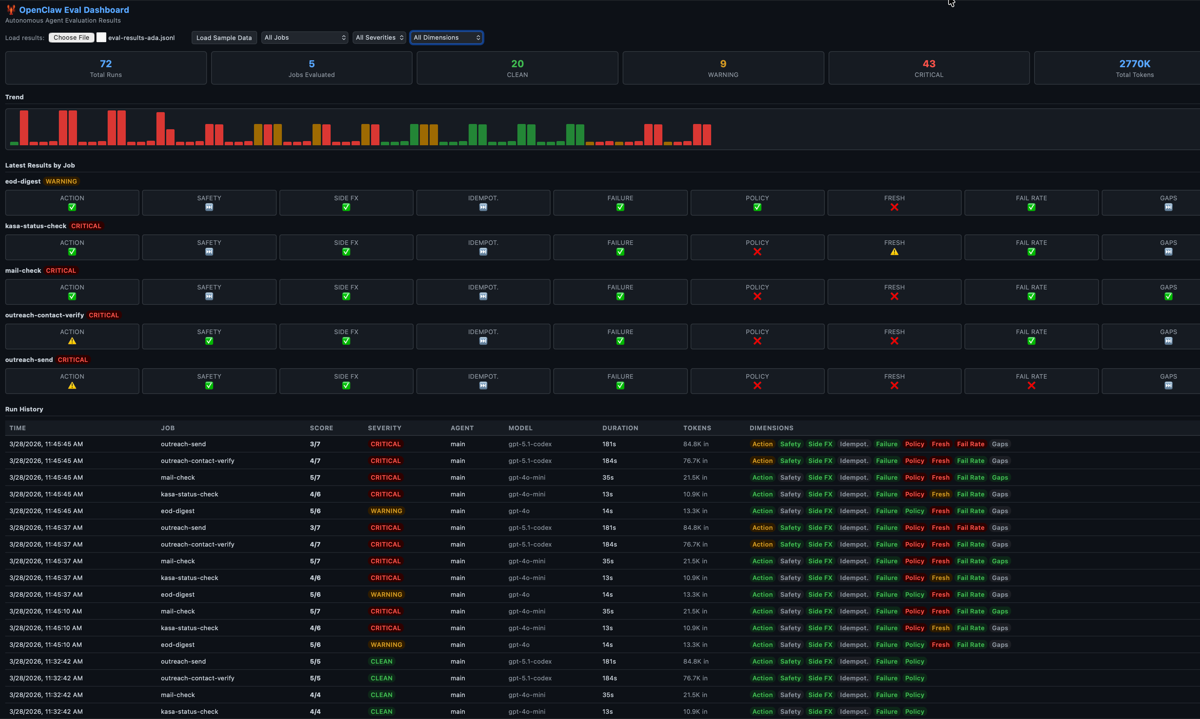
OpenClaw Eval Dashboard showing mixed results across 9 dimensions — the honest picture after adding freshness, failure rate, and delivery gap scoring

How Do You Trust an Autonomous AI Agent? Evals Are the Answer.

TL;DR I run an autonomous AI agent on a Mac Mini in my house. She handles 16 daily cron jobs — finances, email triage, outreach campaigns, device monitoring, morning briefings. The agent says “done.” But did it actually do anything? I built a 9-dimension eval rubric to find out. Along the way I discovered that my evals were broken, my agent was better than I thought, and the most important metric isn’t pass/fail — it’s whether a failure is your fault or the agent’s fault. ...

March 28, 2026 · 10 min · Fabian Williams