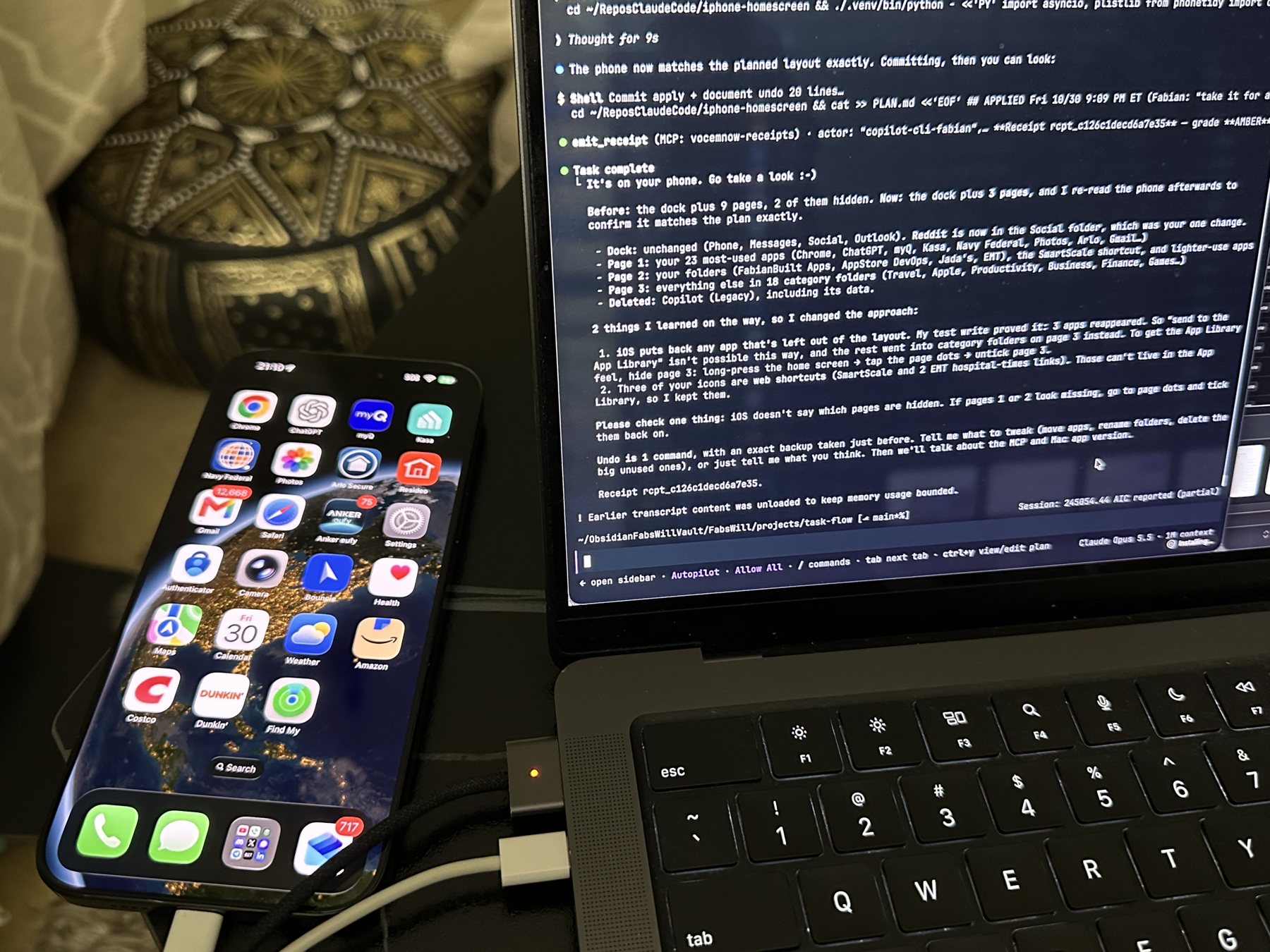
BLUF (bottom line up front): I don’t think software is dead. I don’t think SaaS is dead. I think software just got democratized. On Friday night I went from “huh, cool Reddit post” to my iPhone’s home screen completely reorganized around how I actually use it: 33 minutes, idea to verified on the phone, and I didn’t write a single line of code. A decent model, a good harness, and an idea. The only real limit left is imagination.
Where it started
At 8:36 PM ET I was scrolling r/mcp and saw this post: “I gave Claude access to my iPhone Home Screen through MCP and asked it to organize my apps by color.” The builder made a Mac app, Thumbwise, that reads your home screen over USB and lets an agent rearrange it. Genuinely clever work, and full credit to them for the idea.
One problem: it needs iOS 27. I’m on iOS 26.
And my home screen is a mess. Apps I haven’t opened in years, folders called “iPhoneJunk” (I named that one, so I knew), and a phone that’s filling up. I’ve wanted to audit it for ages and assumed it was impossible. So I plugged the phone into my MacBook Pro and asked my agent one question: can we build our own?

The phone plugged in, and the agent reporting back: from 9 pages to 3.
What happened in those 33 minutes
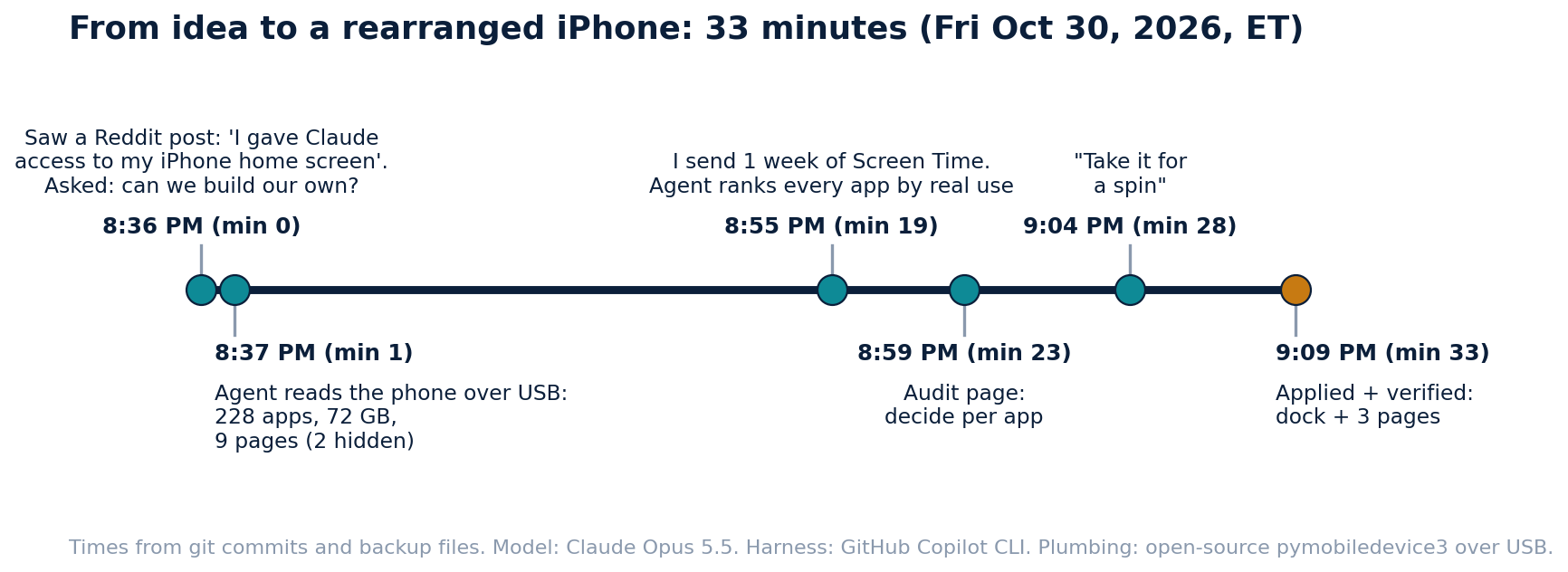
Every time on this chart comes from a git commit or a backup file, not my memory. I’d have sworn it was 10 minutes. The commits say 33.
Minute 1: the agent reached for an open-source library (pymobiledevice3) that talks to an iPhone over USB, and read everything: 228 apps, 72 GB, 20 folders, about 23 widgets, and 9 pages.
Minute 10: it told me I had 9 pages, and I said “that’s not what I see.” By minute 12 it had drawn the whole phone with the real icons, and the mystery was solved: 2 of my 9 pages were hidden. Old widgets plus apps like Slack and Zoho Mail, living on pages I’d switched off and forgotten. I had no idea.
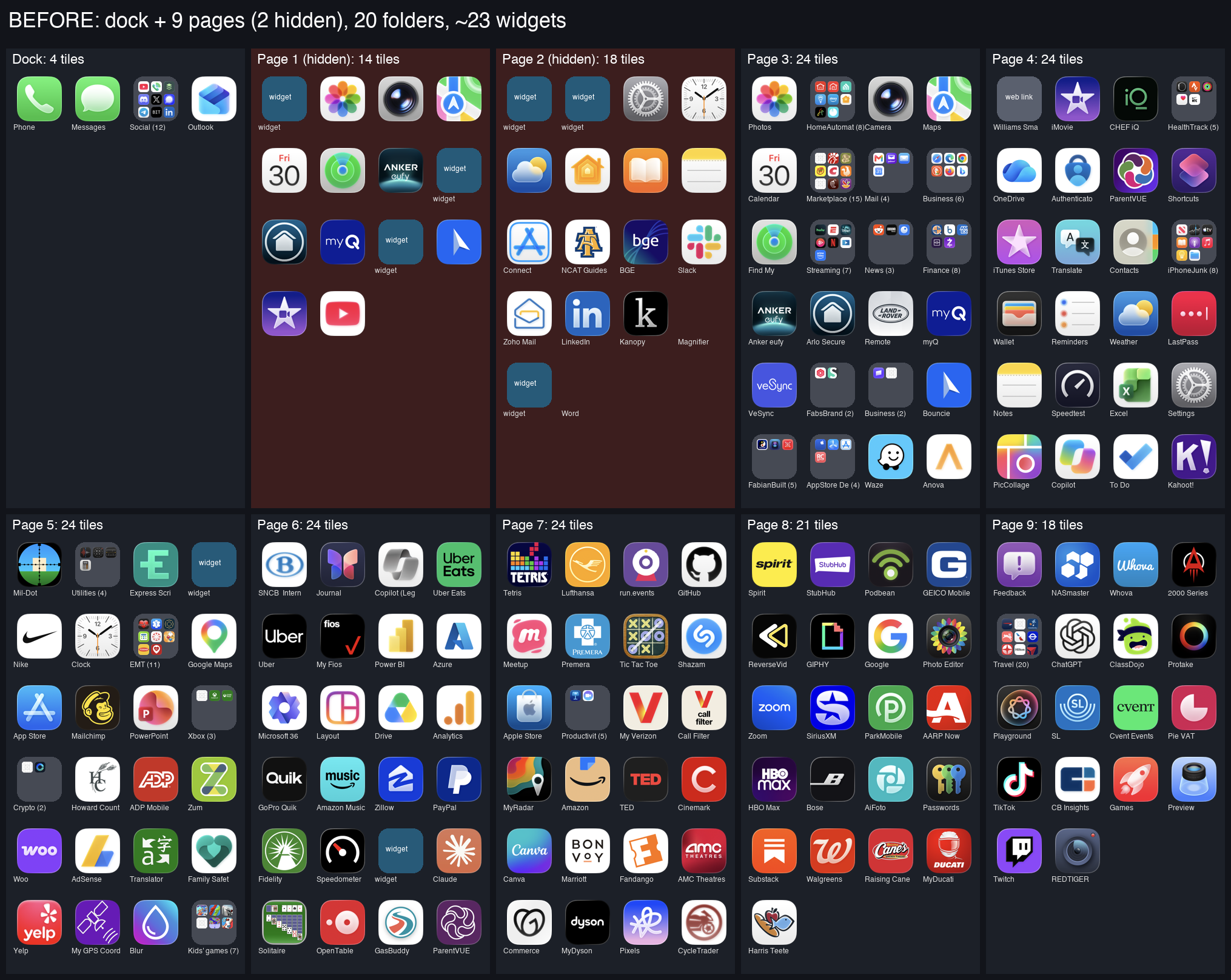
Before: the dock plus 9 pages. The red ones were hidden from me.
Minute 19: I sent it screenshots of 1 week of Screen Time. It matched every name to exactly 1 app and ranked all 228 by what I actually do: hours, pickups, notifications. (X wins. I’m not proud of 11.8 hours.)
Minute 23: it built me an audit page: every app with its icon, size, where it lives today, how much I used it this week, and buttons to decide. The agent proposes; I decide.
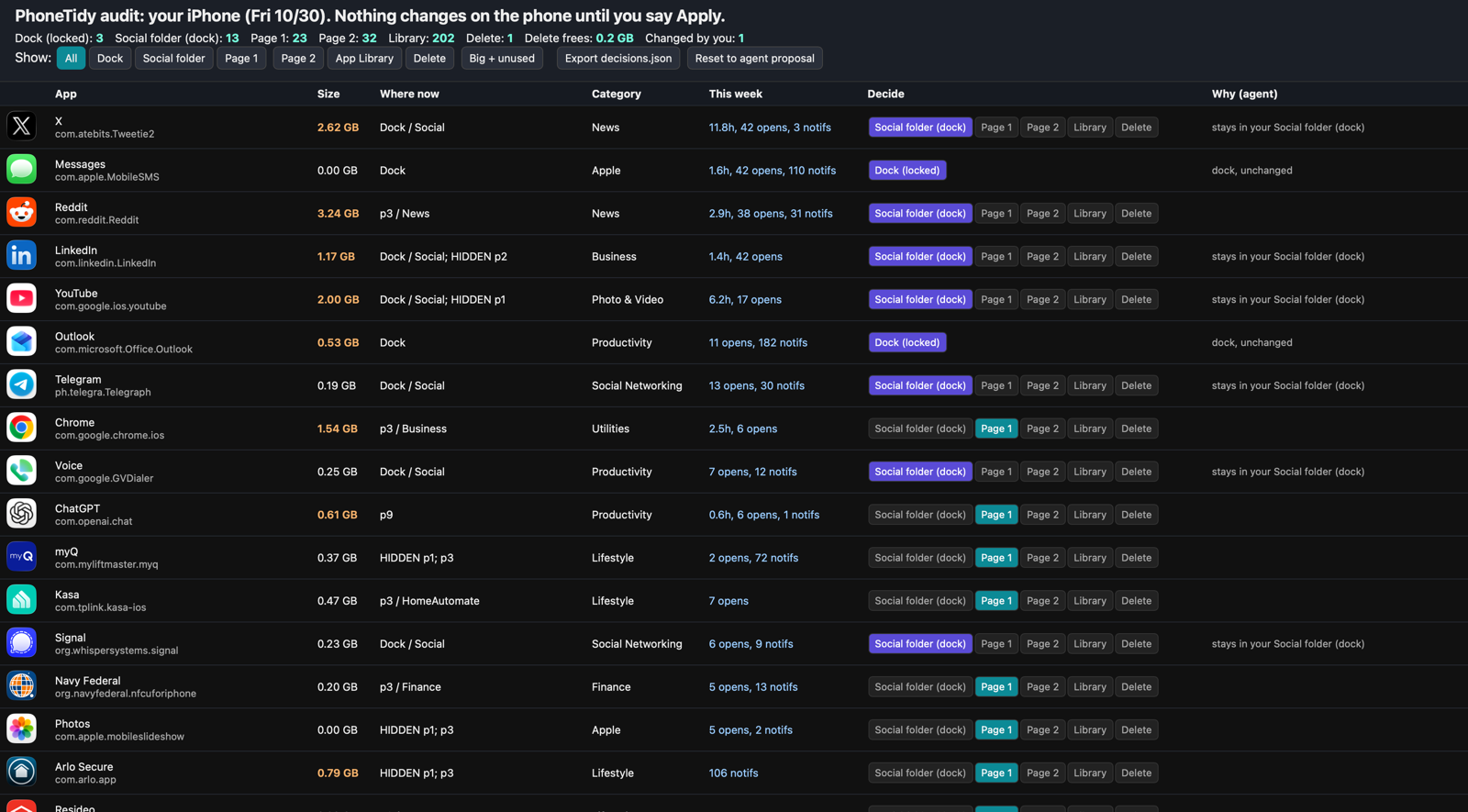
The audit page. Nothing changes on the phone until I say Apply.
Minute 28: I tweaked the top of the list and said “take it for a spin.”
Minute 33: applied, re-read from the phone, and verified: exactly what was planned is what’s on the phone.
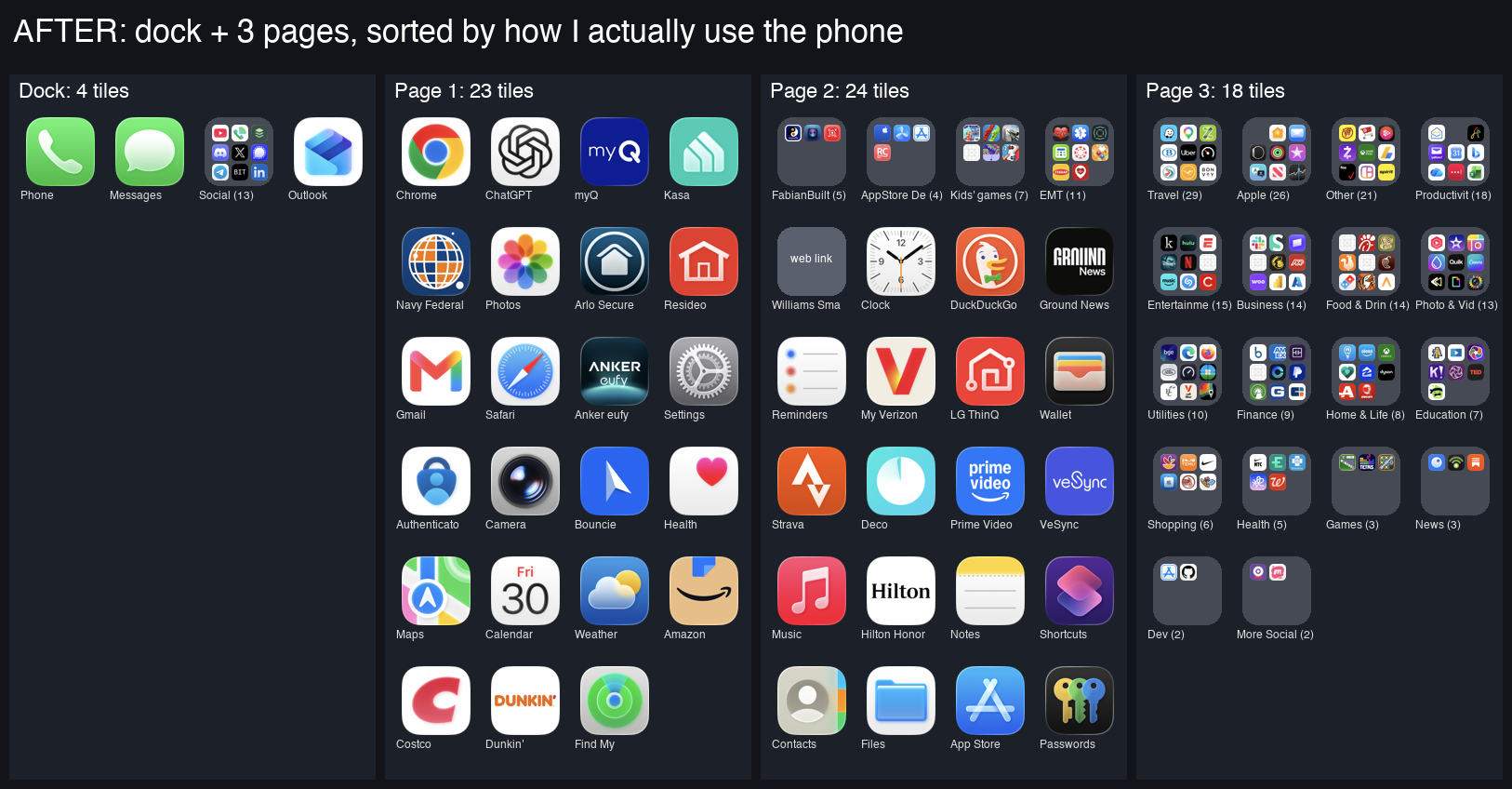
After: my dock untouched, page 1 is my 23 most-used apps, and everything else is filed by category.
It wasn’t magic, and that’s the point
The agent got things wrong, and the interesting part is how they got fixed:
- It wanted to rearrange my dock. Its first proposal swapped my Social folder out for X and Reddit. I said no: the dock is muscle memory. It locked the dock and rebuilt around it.
- iOS fought back. Before touching anything real, it wrote my existing layout back to the phone as a harmless test, and the phone came back different: iOS quietly re-adds any app you leave out. So its plan to “send things to the App Library” couldn’t work. It worked that out from the test, said so, and switched to category folders on page 3.
- It kept a backup of the exact layout before every write. Undo is 1 command.
- It deleted exactly 1 app: an old Copilot (Legacy) duplicate. Every other delete is my call, later.
That’s the shape of all of this for me: the agent does the reading and the plumbing; the checks sit outside the model; the human keeps the OK. Same pattern as my voter guide this week, just pointed at a phone instead of a ballot.
So is software dead?
No. And I’m tired of that framing.
Thumbwise is a real product someone will happily pay $14.99 for, and I hope they do great. I ship apps to the App Store myself (StaleContactsCleaner, WandR). Software and SaaS aren’t dying. What’s changing is who gets to build.
The bar used to be “can you write the code?” Now it’s “can you describe what you want, and can you judge whether what came back is right?” Those are different skills, and a lot more people have them. A nurse who knows exactly what her shift handoff should look like. A small business owner who knows his customers. A dad who’s sick of his iPhone.
What it took on Friday night:
- A decent model (Claude Opus 5.5).
- A good harness (GitHub Copilot CLI), with tools, a terminal, and the ability to try something, check it, and back up.
- Open-source plumbing someone else already built (pymobiledevice3).
- An idea, and the judgment to say no when the first proposal was wrong.
Absolutely none of that is exotic anymore. I can hear the MacBook Pro fan agreeing with me :-)
Where I’m not there yet
- It’s a set of scripts on my Mac, not an app. Next: wrap it as a local MCP server (so any agent can propose a layout and only I can apply it) and then a real Mac app.
- It uses private Apple interfaces. That’s why it has to be a Mac app talking over USB. An iPhone app can’t do this, and the Mac App Store may well say no. Thumbwise sells direct from its own site for the same reason.
- 1 week of usage is thin. We didn’t delete “unused” apps on a week of data, and I’d tell anyone else the same.
- iOS won’t say which pages are hidden, so after the change I had to check by hand that nothing went dark.
- I’m technical. I didn’t write code, but I knew what a USB service or a backup was. The bar dropped a lot; it hasn’t disappeared. The next version should be one button.
Q4U: what’s the thing you’ve always assumed was impossible to build? Try asking.
This is a personal project on my own machines and my own time. By day I work at Microsoft; at home I POC the ideas I take to work :-)